Beyond the Dashboard: How AI Is Quietly Reinventing Your Daily Drive
Beyond the Dashboard: How AI Is Quietly Reinventing Your Daily Drive
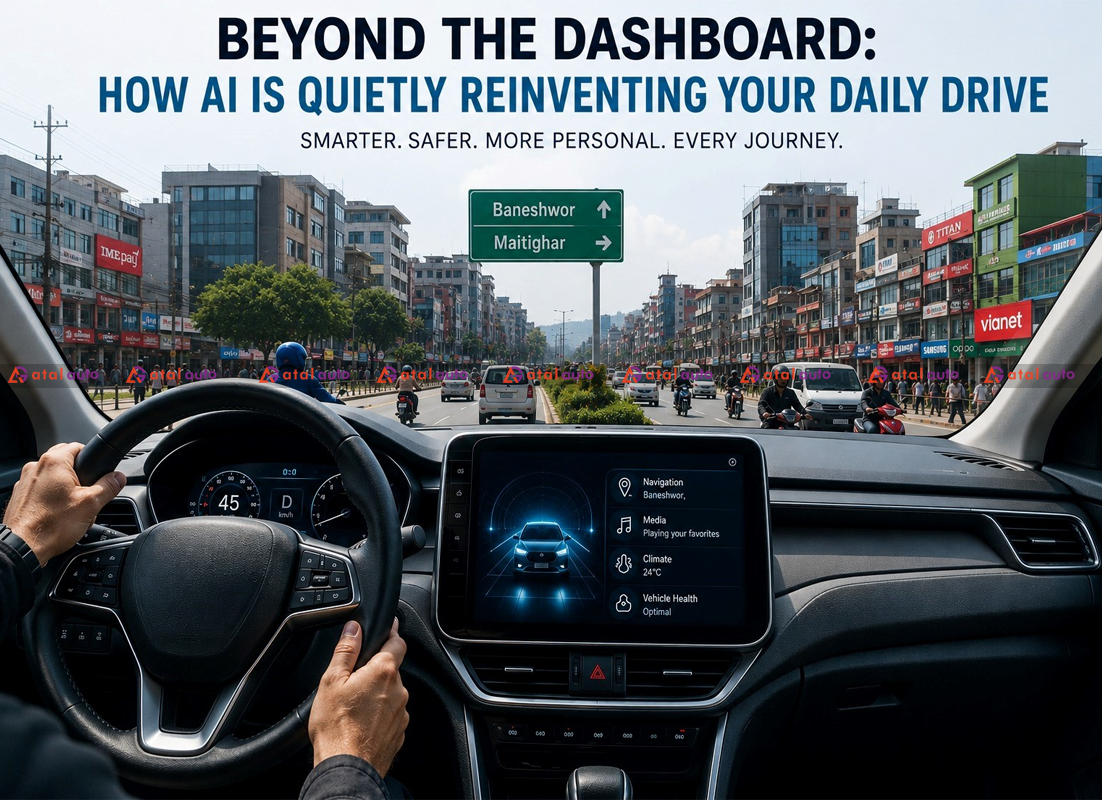
For decades, driving was primarily about the relationship between a person, a vehicle, and the road. You started the car, adjusted the mirrors, followed directions, and controlled the vehicle.
Today, that relationship is changing.
Artificial Intelligence (AI) is becoming an increasingly important part of the modern automotive experience. From intelligent navigation and advanced safety systems to voice assistants, predictive vehicle diagnostics, and smarter energy management, technology is changing how vehicles understand their surroundings and respond to drivers.
The most interesting part is that much of this transformation happens quietly in the background.
You may not always notice AI working while you drive, but it can influence the route you take, the safety warnings you receive, how your vehicle manages energy, and even how the car responds to your preferences.
AI Is Changing More Than Just the Infotainment System
When people hear "AI in cars," they often think about voice assistants, touchscreen displays, or connected entertainment systems.
But automotive AI goes much further.
Modern vehicles can combine information from cameras, radar, ultrasonic sensors, GPS, mapping systems, microphones, and other vehicle sensors. Depending on the vehicle, software and AI-based systems can help interpret this information and support different driving functions.
These technologies can assist with:
- Recognizing nearby vehicles and pedestrians
- Detecting lane markings
- Monitoring blind spots
- Identifying potential collision risks
- Optimizing navigation routes
- Supporting parking maneuvers
- Monitoring certain driver behaviors
- Managing vehicle energy
- Personalizing selected vehicle settings
The result is a vehicle that can become more connected, responsive, and intelligent.
However, it is important to remember that not every intelligent automotive feature is powered exclusively by AI. Modern vehicles typically combine AI and machine learning with sensors, conventional software, mapping data, and electronic control systems.
Smarter Navigation for Everyday Journeys
Navigation is one of the easiest ways for drivers to experience the benefits of intelligent technology.
Traditional navigation systems primarily relied on digital maps and predetermined routes. Modern connected navigation systems can use additional information such as traffic conditions, road closures, travel patterns, and map data to recommend alternative routes.
Imagine leaving work during evening rush hour.
Instead of simply showing you the shortest route, an intelligent navigation system can consider traffic congestion and suggest a different road that may help reduce travel time.
Over time, some systems can also learn frequently used destinations and driving patterns. For example, your vehicle may recognize commonly visited locations such as your workplace, home, or other regular destinations.
This can make every day journeys more convenient and personalized.
For drivers in busy urban areas, where congestion and changing road conditions are common, intelligent navigation can be particularly useful.
AI-Powered Safety: An Extra Layer of Awareness
Safety is one of the most important areas where intelligent technology is transforming modern vehicles.
Advanced Driver Assistance Systems (ADAS) use combinations of cameras, radar, sensors, and software to monitor the vehicle's surroundings.
Depending on the vehicle, these systems may include:
- Forward collision warning
- Automatic emergency braking
- Lane departure warning
- Lane-keeping assistance
- Blind-spot monitoring
- Adaptive cruise control
- Traffic-sign recognition
- Driver attention monitoring
- Parking assistance
For example, if the vehicle detects a potential collision with an object or vehicle ahead, it may warn the driver. In some vehicles, automatic emergency braking can also intervene when specific conditions are met.
These technologies are designed to assist the driver, not replace the driver.
The driver remains responsible for controlling the vehicle and paying attention to the road.
AI and Traffic: Making Urban Driving Smarter
Traffic congestion is one of the biggest challenges faced by drivers in growing cities.
AI and data-driven transportation systems can potentially help analyze traffic patterns and identify congestion more efficiently.
Connected vehicles and navigation platforms can use information from multiple sources to understand changing traffic conditions. This can help drivers choose alternative routes and avoid unnecessary delays.
In the future, communication between vehicles, traffic signals, road infrastructure, and navigation systems could make urban transportation even more intelligent.
Imagine a vehicle approaching a busy intersection and receiving information about traffic-light timing or congestion ahead.
Instead of reacting only to what the driver can see, the vehicle could potentially use connected infrastructure data to provide more useful information.
This is one area where AI, connected vehicles, and smart-city infrastructure could work together to improve mobility.
Your Car Can Become More Personalized
Another important development is personalization.
Depending on the vehicle and its software, intelligent systems can remember selected driver preferences, including:
- Seat settings
- Mirror positions
- Climate-control preferences
- Frequently used destinations
- Driving modes
- Infotainment preferences
- Connectivity settings
For households where multiple people share the same vehicle, driver profiles can make the experience more convenient.
Instead of manually adjusting everything every time you get into the car, certain settings can be automatically restored according to the selected or recognized driver profile.
This is a small change, but it demonstrates an important shift:
The vehicle is becoming more responsive to the individual using it.
Voice Technology Is Making Cars More Conversational
Voice interaction is another area where AI is changing the driving experience.
Older voice-control systems often required drivers to use specific commands. Newer conversational systems are increasingly capable of understanding more natural language.
Instead of navigating through multiple menus, a driver might be able to say:
"Find a nearby charging station."
Or:
"Make the cabin temperature cooler."
Where supported, the system can interpret the request and perform the appropriate action.
This can also reduce the need to physically interact with a touchscreen while driving.
As conversational AI develops further, vehicles could become increasingly similar to intelligent digital assistants.
Predictive Maintenance: Identifying Problems Earlier
AI and vehicle data can also play an important role in maintenance.
Modern vehicles contain numerous sensors that monitor different systems. Some connected vehicles can collect information about components, battery performance, operating conditions, and other parameters.
Advanced diagnostic systems can analyze this information to identify unusual patterns that may indicate a developing problem.
This approach is commonly known as predictive maintenance.
Instead of waiting for a component to fail completely, the system may provide an early warning that inspection or servicing could be required.
For EVs, this can include monitoring battery performance and charging behavior. For conventional vehicles, vehicle data can help monitor various engine, transmission, and electronic systems.
Predictive maintenance will not eliminate mechanical problems, but it could help drivers and service providers identify certain issues earlier.
AI and Electric Vehicles: A Powerful Combination
AI and electric vehicles are becoming increasingly connected.
EVs rely heavily on efficient energy management. Software can help monitor battery usage, optimize energy consumption, and support route planning.
For example, an intelligent navigation system can consider factors such as:
- Current battery level
- Driving distance
- Charging locations
- Route conditions
- Energy consumption
Instead of simply asking:
"How far away is my destination?"
an intelligent EV system can help answer:
"Can I reach my destination efficiently, and where should I charge if necessary?"
As charging infrastructure expands and EV adoption increases, intelligent energy management could become an increasingly important part of the electric driving experience.
AI Is Making Parking Easier
Parking can be challenging, particularly in crowded urban environments.
Modern vehicles can use cameras, ultrasonic sensors, and other technologies to assist drivers when parking.
Depending on the vehicle, these systems can offer:
- 360-degree camera views
- Parking sensors
- Automatic parking assistance
- Surround-view monitoring
- Obstacle detection
- Parking guidance
These technologies can provide drivers with a better view of their surroundings and help reduce the risk of minor parking incidents.
For many drivers, this is one of the most practical examples of technology making everyday driving easier.
The Road Toward Autonomous Driving
AI is also at the center of autonomous-driving development.
For a vehicle to operate autonomously, it needs to understand its surroundings, identify objects, interpret road situations, predict the movement of other road users, and make decisions.
AI and machine-learning systems can help process information from cameras and other sensors to support these tasks.
However, there is an important distinction between driver assistance and autonomous driving.
Most consumer vehicles today still require the driver to remain attentive and responsible.
Features such as adaptive cruise control, lane-keeping assistance, and automatic emergency braking can assist the driver, but they do not necessarily make a vehicle fully autonomous.
The future of autonomous transportation will depend on continued advances in technology, infrastructure, safety validation, regulation, and public acceptance.
Smarter Driving Can Support Sustainability
AI can also contribute to a more efficient automotive future.
Intelligent systems can help optimize routes, reduce unnecessary energy consumption, and improve driving efficiency.
For electric vehicles, smarter energy management can help drivers make better use of available battery capacity.
At a larger scale, AI can also help fleet operators optimize routes and reduce unnecessary idle time.
However, AI alone cannot solve the environmental challenges of transportation.
A more sustainable automotive future will depend on a combination of:
Electric mobility + renewable energy + efficient vehicles + sustainable materials + smarter transportation systems.
AI can become an important part of that larger transition.
The Human Driver Still Matters
Despite all these technological developments, the human driver remains essential.
AI systems and sensors have limitations. Weather, poor visibility, road conditions, unusual situations, sensor obstructions, and technical limitations can affect how these systems perform.
That is why drivers should understand what their vehicle's technology can and cannot do.
Safety features should be treated as assistance—not a replacement for responsible driving.
The best automotive technology may not be the technology that completely takes control away from the driver.
Instead, it may be technology that helps the driver:
See better. Understand more. React sooner. And drive smarter.
What Will the AI-Powered Car of the Future Look Like?
The next generation of vehicles is likely to become even more connected and personalized.
Future vehicles could potentially:
- Communicate with smart infrastructure
- Provide more advanced driver assistance
- Optimize energy consumption
- Detect certain mechanical issues earlier
- Understand natural voice commands
- Personalize the driving environment
- Improve route planning
- Integrate more closely with smartphones and digital services
The dashboard itself may eventually become less important.
Instead of constantly looking at screens and buttons, drivers may interact with their vehicles naturally through voice, connected services, automated settings, and intelligent assistance.
The technology may become less visible—but more useful.
Final Thoughts
AI is not transforming the automotive industry through one dramatic invention.
It is happening gradually, feature by feature.
It is in the navigation system that finds a better route.
It is in the camera that detects a pedestrian.
It is in the safety system that warns about a potential collision.
It is in the software that remembers your preferences.
It is in the EV system that helps manage battery energy.
And it is increasingly becoming part of the systems working quietly behind the scenes.
The future of driving may not be about putting more technology on the dashboard.
It may be about making technology smart enough to work behind the dashboard—helping drivers enjoy a safer, smoother, more efficient, and more connected journey.
The smartest car of the future may be the one that makes advanced technology feel almost invisible.

