Future of Automotive Safety: What New Cars Will Offer by 2030
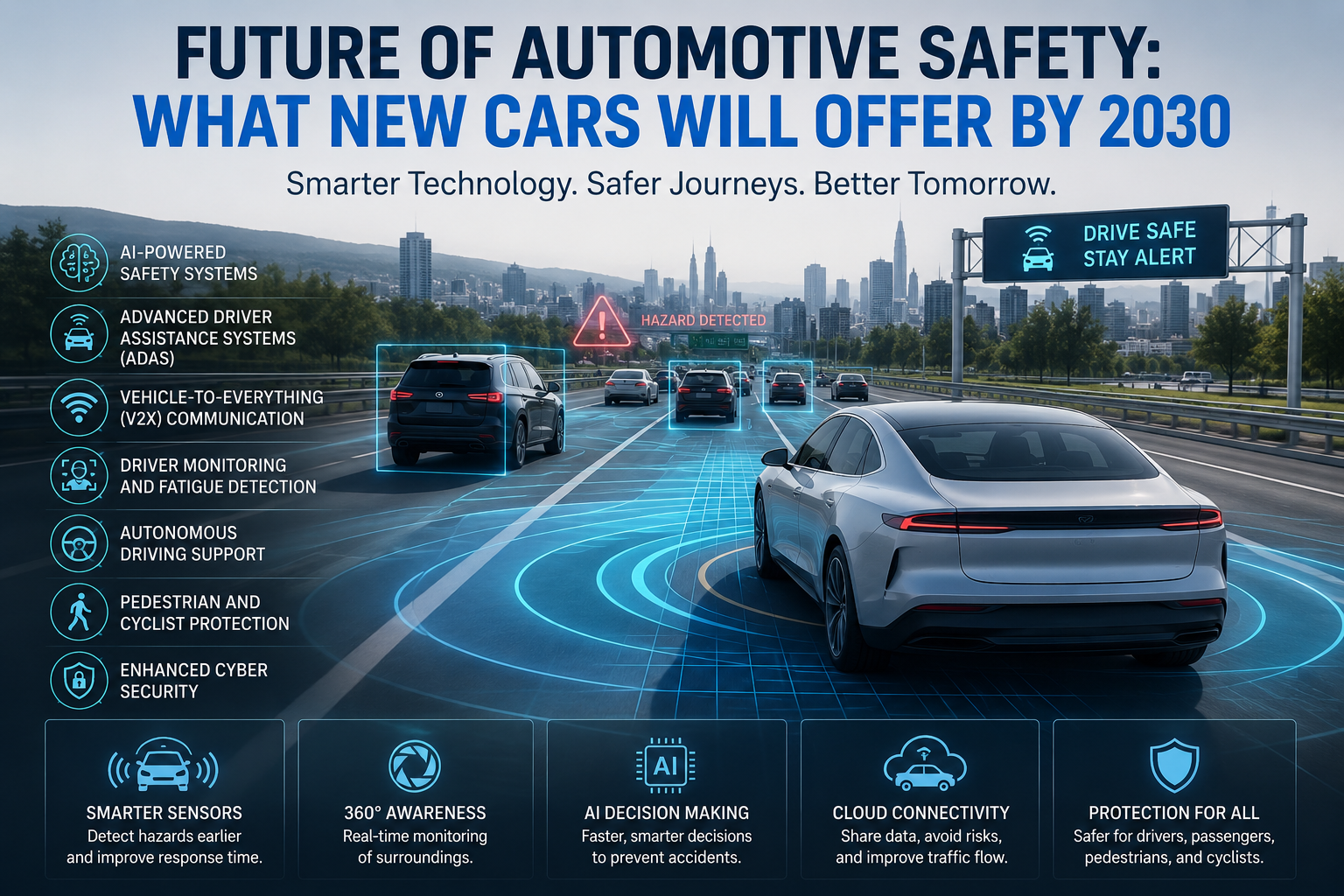
Key Highlights
-
Advanced driver assistance systems will become standard in most new vehicles.
-
Cars will be able to detect hazards earlier and react faster than human drivers.
-
Artificial intelligence will play a major role in preventing accidents.
-
Vehicle-to-vehicle communication could help reduce traffic collisions.
-
Driver monitoring systems will become more sophisticated.
-
Pedestrian and cyclist protection technologies will continue to improve.
-
Autonomous driving features will become more common in everyday vehicles.
-
Safety will increasingly be a deciding factor when buying a car.
Table of Contents
-
Introduction
-
How Automotive Safety Has Evolved
-
The Growing Role of Artificial Intelligence
-
Advanced Driver Assistance Systems Will Become Standard
-
Smarter Collision Prevention Technology
-
Vehicle-to-Vehicle and Vehicle-to-Infrastructure Communication
-
Driver Monitoring Systems and Fatigue Detection
-
The Rise of Semi-Autonomous Driving
-
Improved Protection for Pedestrians and Cyclists
-
Enhanced Safety Through Connected Vehicles
-
Cybersecurity and Vehicle Safety
-
What These Changes Mean for Car Buyers
-
The Future of Road Safety Beyond 2030
-
Conclusion
Introduction
The automotive industry has changed dramatically over the past few decades. Not long ago, power steering, anti-lock braking systems, and airbags were considered premium features available only in expensive vehicles. Today, many of these technologies are standard in even the most affordable cars.
Safety has always been one of the most important aspects of vehicle design. Every year, manufacturers invest billions of dollars in research and development to make vehicles safer for drivers, passengers, pedestrians, and everyone else on the road.
As we move closer to 2030, automotive safety is entering a new era. Modern vehicles are becoming smarter, more connected, and increasingly capable of helping drivers avoid accidents before they happen. The focus is no longer only on protecting people during a crash. Instead, the goal is to prevent crashes from occurring in the first place.
This shift is being driven by advances in artificial intelligence, sensors, cameras, radar systems, and vehicle connectivity. Features that once seemed futuristic are gradually becoming part of everyday driving.
For consumers, these developments will bring significant benefits. Cars will not only become safer but also easier and less stressful to drive. Whether you are a first-time buyer, a family looking for a reliable vehicle, or someone planning to upgrade to a newer model, understanding these changes can help you make better decisions in the future.
How Automotive Safety Has Evolved
To understand where automotive safety is heading, it helps to look at how far it has already come.
In the early days of motoring, safety features were extremely limited. Seat belts were not widely used, airbags did not exist, and vehicle structures offered little protection during collisions.
Over time, regulations and technological advancements led to major improvements. Seat belts became mandatory in many countries. Airbags were introduced. Anti-lock braking systems improved vehicle control during emergency braking situations.
Later came electronic stability control, traction control, parking sensors, rearview cameras, and advanced crash protection systems. These innovations helped reduce injuries and fatalities significantly.
Today, many vehicles include automatic emergency braking, lane departure warning systems, blind-spot monitoring, and adaptive cruise control. These technologies actively assist drivers rather than simply protecting them after an accident occurs.
The next step is making vehicles intelligent enough to anticipate and avoid danger with minimal human intervention.
The Growing Role of Artificial Intelligence
Artificial intelligence is expected to become one of the most important components of automotive safety by 2030.
Modern vehicles already collect enormous amounts of information through cameras, radar sensors, ultrasonic sensors, and onboard computers. Artificial intelligence allows vehicles to analyze this information in real time and make decisions much faster than a human driver.
For example, an AI-powered system can identify a pedestrian stepping onto the road, calculate potential collision risks, and activate emergency braking within fractions of a second.
By 2030, these systems are expected to become far more advanced.
Cars will be able to recognize complex traffic situations, predict the behavior of nearby vehicles, identify dangerous road conditions, and provide proactive warnings to drivers.
Artificial intelligence may also learn from individual driving habits. Vehicles could identify signs of distraction, fatigue, or unusual behavior and recommend corrective actions before an accident occurs.
The ultimate goal is simple: fewer accidents, fewer injuries, and safer roads for everyone.
Advanced Driver Assistance Systems Will Become Standard
One of the biggest changes expected by 2030 is the widespread adoption of Advanced Driver Assistance Systems, commonly known as ADAS.
Today, many of these features are available only in mid-range and premium vehicles. Over the next few years, they are likely to become standard equipment in most new cars.
These systems include:
-
Automatic Emergency Braking
-
Adaptive Cruise Control
-
Lane Keeping Assist
-
Blind Spot Monitoring
-
Rear Cross Traffic Alert
-
Traffic Sign Recognition
-
Forward Collision Warning
As costs continue to decrease, manufacturers will be able to include these technologies across a wider range of vehicles.
This means that even budget-friendly cars may offer safety levels that would have been considered luxury-class just a few years ago.
For buyers, this is excellent news. Safer vehicles will become accessible to more people than ever before.
Smarter Collision Prevention Technology
Future collision prevention systems will go beyond simply reacting to immediate dangers.
By 2030, many vehicles may be able to predict potential accidents several seconds before they occur.
Using multiple sensors and advanced algorithms, vehicles will continuously monitor surrounding traffic patterns.
If a nearby driver suddenly changes lanes aggressively, brakes unexpectedly, or appears distracted, your vehicle may identify the risk early and prepare safety systems in advance.
Some systems may automatically adjust speed, steering, or braking inputs to reduce the likelihood of a collision.
This proactive approach represents one of the most important developments in automotive safety.
Rather than responding to accidents, future vehicles will focus on preventing them altogether.

