Which Is Better for Nepalese Roads: Hatchback or SUV?
Key Highlights
-
Understand the main differences between hatchbacks and SUVs.
-
Learn how Nepal's road conditions affect vehicle choice.
-
Compare ground clearance, comfort, fuel economy, and maintenance costs.
-
Discover which vehicle type is best for city driving, highways, and rural roads.
-
Explore ownership costs and resale value in the Nepalese market.
-
Find out which option suits different lifestyles and budgets.
Table of Contents
-
Introduction
-
Understanding Hatchbacks and SUVs
-
Nepal's Unique Road Conditions
-
Ground Clearance: Why It Matters in Nepal
-
City Driving: Hatchback vs SUV
-
Comfort and Passenger Space
-
Fuel Efficiency and Running Costs
-
Maintenance and Repair Expenses
-
Safety Considerations
-
Performance on Highways and Mountain Roads
-
Parking and Maneuverability
-
Resale Value in Nepal
-
Which Vehicle Suits Different Types of Buyers?
-
Popular Hatchbacks and SUVs in Nepal
-
Final Verdict
-
Conclusion
Introduction
Buying a car in Nepal is rarely a simple decision. Unlike many countries where roads are relatively predictable, Nepal presents drivers with a unique mix of driving conditions. A single journey may involve smooth city roads, rough village tracks, steep mountain climbs, potholes, gravel sections, and heavy traffic congestion.
Because of these diverse conditions, many buyers find themselves asking the same question:
Should I buy a hatchback or an SUV?
The answer is not always straightforward. Both vehicle types have their own strengths and weaknesses. What works perfectly for one family may not be the ideal choice for another.
A hatchback is often seen as practical, economical, and easy to drive. An SUV, on the other hand, is associated with higher ground clearance, better road presence, and the ability to tackle rough terrain more confidently.
Over the last decade, Nepal has witnessed a significant shift in consumer preference. SUVs have become increasingly popular, and almost every major automobile brand now offers multiple SUV options. Yet hatchbacks continue to attract buyers because of their affordability, efficiency, and convenience.
Before making a purchase, it is important to understand how each vehicle performs in real Nepalese driving conditions.
Understanding Hatchbacks and SUVs
Before comparing them, let's briefly understand what these vehicle categories actually are.
What Is a Hatchback?
A hatchback is a compact passenger vehicle with a rear door that opens upward, providing access to the cargo area.
Popular hatchbacks in Nepal include:
-
Maruti Suzuki Swift
-
Hyundai Grand i10
-
Hyundai i20
-
Suzuki Celerio
-
Tata Tiago
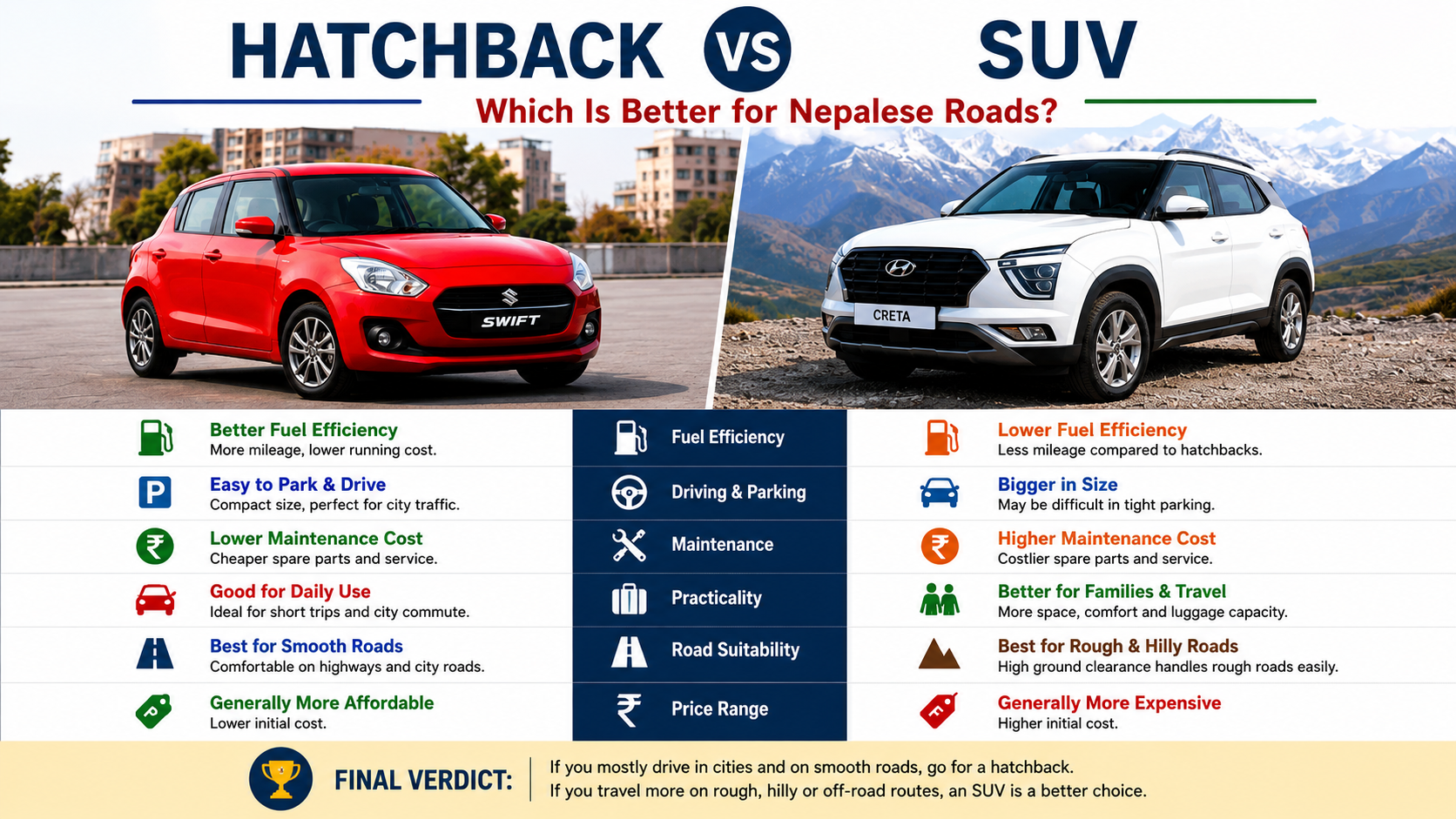
These vehicles are generally smaller, lighter, and more fuel-efficient than SUVs.
Advantages of Hatchbacks
-
Lower purchase price
-
Better fuel economy
-
Easier parking
-
Lower maintenance costs
-
Suitable for city driving
Disadvantages of Hatchbacks
-
Lower ground clearance
-
Less luggage space
-
Limited off-road capability
-
Less commanding driving position
What Is an SUV?
SUV stands for Sport Utility Vehicle.
Modern SUVs range from compact urban crossovers to large seven-seater family vehicles.
Popular SUVs in Nepal include:
-
Hyundai Creta
-
Kia Seltos
-
Suzuki Brezza
-
Mahindra Scorpio
-
Toyota Rush
-
Hyundai Venue
SUVs are designed to provide higher ground clearance, better visibility, and more interior space.
Advantages of SUVs
-
Higher ground clearance
-
Better visibility
-
More cabin space
-
Greater confidence on rough roads
-
Better capability in difficult terrain
Disadvantages of SUVs
-
Higher purchase price
-
Lower fuel efficiency
-
More expensive maintenance
-
Larger parking space required
Nepal's Unique Road Conditions
Choosing between a hatchback and an SUV becomes easier when we consider Nepal's roads.
Road conditions vary dramatically across the country.
In Kathmandu, drivers face:
-
Traffic congestion
-
Narrow roads
-
Frequent speed breakers
-
Limited parking
Outside major cities, drivers often encounter:
-
Uneven surfaces
-
Gravel roads
-
Muddy sections during monsoon
-
Steep climbs
-
Landslide-prone routes
Even within urban areas, road conditions can change quickly due to ongoing construction projects.
This reality is one reason SUVs have become increasingly attractive to Nepalese buyers.
However, not everyone regularly drives on rough roads. Many people spend almost all their time within city limits, where the benefits of a hatchback become more noticeable.
Ground Clearance: Why It Matters in Nepal
If there is one factor that strongly influences vehicle choice in Nepal, it is ground clearance.
Ground clearance refers to the distance between the lowest part of the vehicle and the road surface.
Many hatchbacks offer ground clearance between 165 mm and 180 mm.
Most SUVs provide between 190 mm and 220 mm.
While this difference may seem small on paper, it becomes very noticeable on real roads.
Benefits of Higher Ground Clearance
-
Easier navigation over potholes
-
Better performance on rough roads
-
Reduced risk of underbody damage
-
Greater confidence during monsoon season
-
Improved ability to cross uneven surfaces
For drivers who frequently travel outside major cities, higher ground clearance can make everyday driving significantly easier.
However, if your driving is mostly limited to Kathmandu, Pokhara, or other urban centers, the lower ground clearance of a hatchback may not create major problems.
City Driving: Hatchback vs SUV
Urban driving is where hatchbacks truly shine.
Nepalese cities are becoming increasingly crowded.
Parking spaces are limited.
Roads are often narrow.
Traffic congestion is common.
Under these conditions, a smaller vehicle provides several advantages.
Why Hatchbacks Excel in Cities
-
Easier to park
-
Better maneuverability
-
Lower fuel consumption
-
Easier lane changes
-
Reduced stress in traffic
For daily office commuting, school runs, and shopping trips, a hatchback often feels more convenient.
SUVs can still perform well in cities, but their larger dimensions may make parking and maneuvering slightly more challenging.
That said, many modern compact SUVs have become surprisingly city-friendly.
Vehicles such as the Hyundai Venue and Suzuki Brezza offer a good balance between urban usability and SUV practicality.
Comfort and Passenger Space
Comfort is another area where SUVs often have an advantage.
Most SUVs provide:
-
Higher seating position
-
More legroom
-
Larger cargo space
-
Easier entry and exit
Long-distance journeys become more comfortable when passengers have additional space to move around.
Families travelling frequently between cities often appreciate the added comfort provided by SUVs.
However, modern hatchbacks have improved significantly.
Cars such as the Hyundai i20 offer surprisingly spacious interiors that can comfortably accommodate small families.
For a family of four primarily driving within cities, a hatchback may provide more than enough space while keeping ownership costs lower.
Fuel Efficiency and Running Costs
Fuel prices remain a major concern for Nepalese drivers.
This is one area where hatchbacks usually outperform SUVs.
Because hatchbacks are lighter and use smaller engines, they typically consume less fuel.
A modern hatchback may deliver:
-
18–25 km/l under favorable conditions
Many SUVs provide:
-
12–18 km/l depending on size and driving style
Over several years of ownership, this difference can translate into significant savings.
For budget-conscious buyers, fuel efficiency often becomes one of the strongest arguments in favor of a hatchback.
Conclusion
There is no universal winner in the hatchback versus SUV debate.
The better choice depends entirely on how and where you drive.
If your daily routine involves city commuting, limited parking, and a focus on fuel economy, a hatchback remains one of the smartest vehicle choices available.
On the other hand, if you frequently travel on rough roads, visit rural areas, take long family trips, or simply want additional ground clearance and comfort, an SUV is likely the better investment.
For many Nepalese buyers today, compact SUVs offer an excellent middle ground by combining the practicality of a hatchback with many advantages of a traditional SUV.
Before making a purchase, consider your budget, driving habits, family size, and future needs. A vehicle that matches your lifestyle will always provide greater satisfaction than simply following market trends.
The best car is not necessarily the most expensive or the most popular. It is the one that fits your daily life and helps you drive with confidence on Nepal's diverse roads.

