CG Motors Launches JMEV-3 Electric Hatchback in Nepal
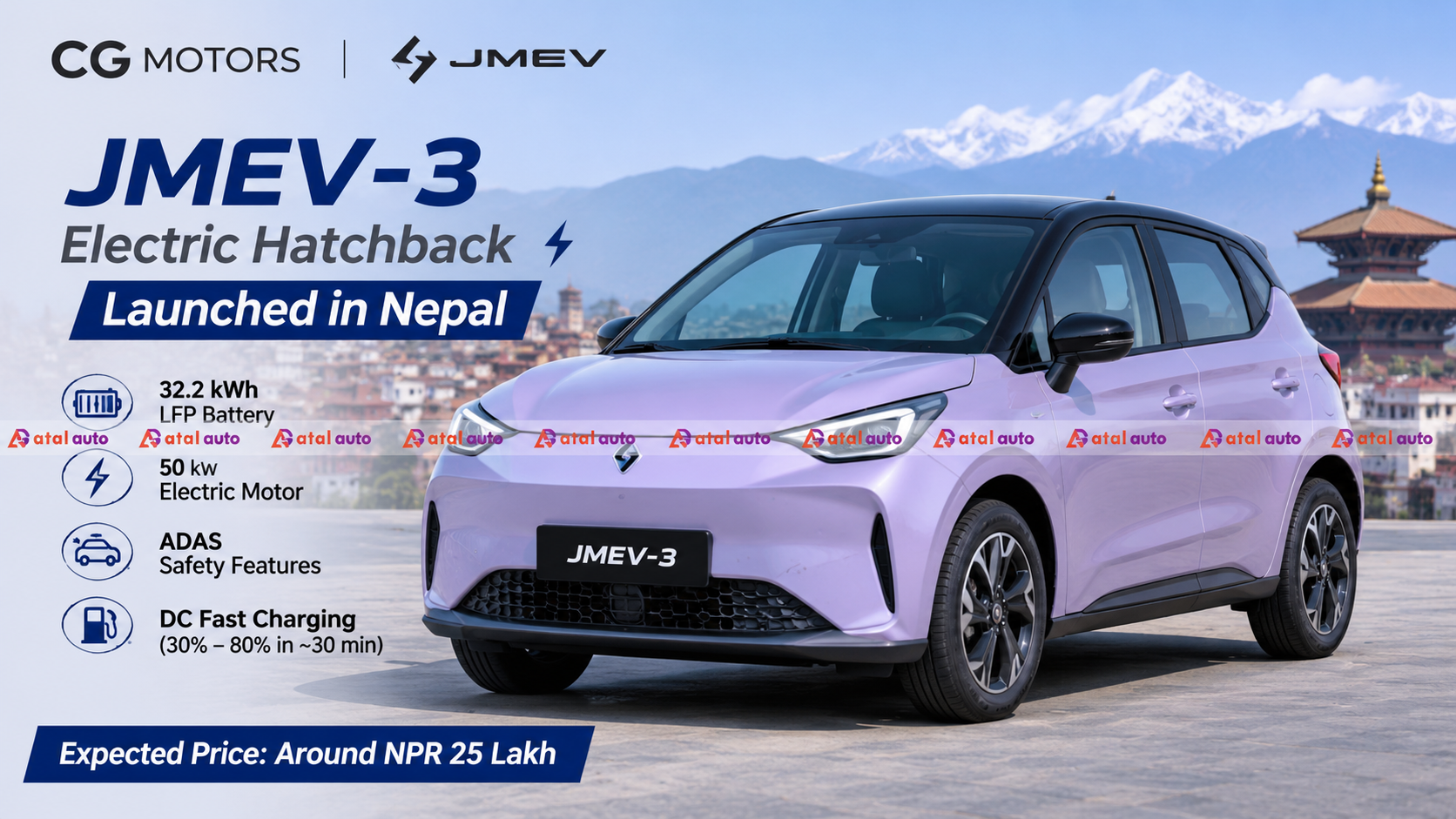 Nepal's electric vehicle market continues to welcome new models, and this time, a compact electric hatchback has joined the growing competition. CG Motors has brought the JMEV-3 electric car to Nepal, adding another option for customers looking for a relatively affordable electric vehicle for everyday use.
The arrival of the JMEV-3 is particularly interesting for buyers who do not necessarily need a large electric SUV. With its compact dimensions, five-seat layout, 32.2 kWh battery and a collection of modern driving assistance features, the new hatchback is aimed at customers who want a practical electric car for city travel.
The vehicle is manufactured by JMEV, an electric vehicle brand associated with China's Jiangling Motors Group. The company already has a connection with Nepal through its electric taxi offering. The arrival of the JMEV-3 brings the brand into another part of the passenger vehicle market.
According to reports published by Meroauto, 55 units of the JMEV-3 had already entered Nepal during Ashoj 2083. Although the company has not officially announced the retail price, the vehicle is expected to cost around NPR 25 lakh.
If the estimated price is maintained, the JMEV-3 could attract buyers searching for a compact electric hatchback without moving into the higher price brackets occupied by larger EVs.
JMEV-3 Arrives in Nepal Through CG Motors
CG Motors has brought the JMEV-3 electric hatchback to Nepal at a time when demand for smaller electric vehicles is gradually expanding. While the Nepali EV market has seen considerable interest in electric SUVs, not every customer needs a vehicle with a large body or a high-capacity battery.
For many households, a smaller car is more practical. It takes up less parking space, is easier to manoeuvre through narrow streets and can be convenient for daily commuting.
The JMEV-3 appears to have been developed with this kind of everyday use in mind. Its compact body and five-seat configuration make it suitable for individuals, couples and small families who need a vehicle for regular city travel.
Its arrival also adds another Chinese electric vehicle manufacturer to Nepal's increasingly competitive automotive market. Buyers now have more choices across different vehicle sizes, battery capacities and price categories.
However, the final success of the JMEV-3 will depend heavily on its official price, driving range, warranty coverage and the after-sales support available in Nepal.
JMEV-3 Electric Car Price in Nepal
Price will be one of the most important factors determining the popularity of the JMEV-3.
At present, its official price in Nepal has not been announced. Based on available automotive reporting, the expected price is approximately NPR 25 lakh.
If the vehicle enters the market at around this price, it could become an interesting option for people planning to purchase their first electric car or replace an older petrol-powered hatchback.
However, customers should remember that NPR 25 lakh is an estimated figure, not a confirmed showroom price. The final price may depend on the official variant, applicable taxes, dealer pricing and available promotional offers.
For buyers comparing electric vehicles, it is also important to consider the complete ownership cost rather than focusing only on the initial purchase price.
Electric cars generally have fewer moving mechanical components than conventional petrol vehicles. They do not require engine oil changes, and their regenerative braking systems can help reduce brake wear under suitable driving conditions.
Nevertheless, battery condition, tyre replacement, suspension maintenance, insurance and charging expenses remain part of EV ownership.
JMEV-3 Battery and Motor Specifications
One of the main attractions of the JMEV-3 is its battery and electric motor combination.
The hatchback comes with a 32.2 kWh Lithium Iron Phosphate (LFP) battery. It is paired with a 50 kW electric motor that produces 125 Nm of torque.
These specifications suggest that the JMEV-3 is designed for regular commuting and urban driving rather than high-performance driving.
Unlike conventional petrol engines, electric motors deliver torque almost immediately. This can make a noticeable difference when moving away from traffic lights, navigating busy intersections or driving through stop-and-go traffic.
Here is a look at the reported specifications of the JMEV-3.
| Specifications | JMEV-3 |
|---|---|
| Vehicle type | Electric hatchback |
| Manufacturer | JMEV |
| Parent group | Jiangling Motors Group |
| Battery capacity | 32.2 kWh |
| Battery chemistry | Lithium Iron Phosphate (LFP) |
| Motor power | 50 kW |
| Maximum torque | 125 Nm |
| Drive system | Front-wheel drive |
| Top speed | Approximately 102 km/h |
| Seating capacity | 5 passengers |
| Length | 3,720 mm |
| Width | 1,640 mm |
| Height | 1,535 mm |
| Wheelbase | 2,390 mm |
| Front suspension | MacPherson independent |
| Rear suspension | Torsion beam |
The 50 kW motor may not sound particularly powerful compared with larger electric SUVs, but that is not necessarily a disadvantage for a compact hatchback.
For its intended purpose, the combination of a relatively small body, electric motor and instant torque could provide a convenient driving experience.
One important detail is still missing: the officially confirmed driving range for the Nepal-bound model. Buyers should wait for the manufacturer or distributor to publish the local specification rather than relying on figures from different international variants.
32.2 kWh LFP Battery: What Does It Mean for Buyers?
The JMEV-3 uses an LFP battery, which stands for Lithium Iron Phosphate.
LFP batteries have become increasingly popular in electric vehicles because of their durability, thermal stability and suitability for regular charging cycles.
Compared with some other lithium-ion battery chemistries, LFP batteries generally offer good cycle life and are considered relatively stable under normal operating conditions.
For everyday users, this can be an attractive feature. People who use their electric vehicles regularly want a battery that can handle repeated charging and discharging without unnecessary concerns.
However, battery performance depends on several factors, including temperature, charging habits, battery management software and overall vehicle design.
The 32.2 kWh capacity places the JMEV-3 in the compact EV category. It should be considered in relation to the vehicle's size and intended usage rather than compared directly with the larger battery packs found in electric SUVs.
For people travelling mainly within Kathmandu Valley, a compact EV with a suitable real-world range could be sufficient for daily commuting.
For those who frequently travel outside the valley, the actual range, charging speed and availability of charging stations will be much more important.
Charging Time and Convenience
Charging convenience is another important consideration for anyone planning to purchase an electric vehicle in Nepal.
According to the available report, the JMEV-3 supports DC fast charging, with the battery reportedly charging from 30% to 80% in approximately 30 minutes.
This is useful for drivers who need to recharge during a journey rather than waiting for a longer charging session.
For example, someone travelling outside Kathmandu may find DC fast charging helpful when stopping at a suitable charging station along the route.
However, the charging time should not be considered a complete picture of the vehicle's charging capability. The maximum DC charging power, AC charging time and compatible charging connector specifications have not yet been confirmed for the Nepal-specific model.
These details are worth checking before purchasing.
Home charging is another important consideration. Buyers who have access to a dedicated parking space and a suitable electrical connection may find everyday charging more convenient than depending entirely on public charging stations.
Before purchasing the JMEV-3, customers should ask CG Motors about the supplied charger, installation requirements, charging compatibility and warranty conditions for the battery and charging equipment.
Compact Dimensions Designed for Urban Driving
The JMEV-3 measures 3,720 mm in length, 1,640 mm in width and 1,535 mm in height. It has a wheelbase of 2,390 mm.
These dimensions place it firmly in the compact hatchback category.
For Nepalese cities, particularly Kathmandu, vehicle size can make a real difference. Narrow roads, crowded intersections, roadside parking and limited residential parking spaces often make smaller vehicles more convenient.
The JMEV-3's compact dimensions could help drivers navigate these conditions more comfortably than they might in a larger SUV.
Its five-seat configuration also makes it more practical than some two-seat or very small urban electric vehicles.
The vehicle uses MacPherson independent suspension at the front and a torsion beam suspension setup at the rear.
This is a familiar suspension arrangement in compact passenger cars. It is generally designed to balance everyday ride comfort, packaging requirements and manufacturing cost.
Still, the actual ride quality on Nepal's roads will depend on suspension tuning, tyre specifications, ground clearance and the condition of the road.
Potential buyers should take the car for a test drive, especially over uneven roads, speed breakers and inclines, before making a final decision.
ADAS and Safety Features
Safety equipment is becoming an increasingly important consideration in Nepal's electric vehicle market.
The JMEV-3 is reported to come with Advanced Driver Assistance Systems (ADAS), along with several features intended to make everyday driving easier.
Some of its reported safety and assistance features include:
Blind Spot Monitoring: This system helps drivers become aware of vehicles approaching or travelling in adjacent lanes. It can be particularly useful when changing lanes in busy traffic.
Hill Start Assist: Starting a vehicle on an uphill road can sometimes be challenging, especially in stop-and-go traffic. Hill Start Assist helps reduce the possibility of the vehicle rolling backwards when moving off on an incline.
Rear Parking Sensors: Parking sensors help drivers identify obstacles behind the vehicle while reversing. This is particularly useful in crowded residential areas and tight parking spaces.
Advanced Driver Assistance System: ADAS refers to a group of technologies designed to support the driver and improve awareness of surrounding traffic conditions. The exact functions included in the Nepal-specific vehicle should be confirmed with the distributor.
The dashboard also features a 10.1-inch touchscreen infotainment system and a 5-inch driver information display.
Some international-market versions of the JMEV-3 are offered with additional equipment, including a 360-degree camera, smartphone application connectivity and battery temperature management.
However, these features should not automatically be assumed to be available in the Nepal-bound version. The final equipment list may differ by market and variant.
It is also worth noting that the presence of ADAS does not automatically establish a vehicle's crash safety rating. Buyers should check the exact safety equipment, airbag configuration and any available independent crash-test results before making a decision.
Interior and Practicality
A compact electric hatchback needs to balance cabin comfort with exterior dimensions.
The JMEV-3 offers seating for five passengers, making it a practical proposition for small families and everyday personal use.
The 10.1-inch touchscreen is likely to be one of the main attractions inside the cabin. Modern infotainment systems have become an important part of the driving experience, allowing drivers to access vehicle information and entertainment features through a central display.
The separate 5-inch information screen provides another display area for essential driving information.
Although the available specifications provide a useful overview, details such as boot capacity, rear-seat space, seat adjustment, upholstery, air conditioning controls and smartphone connectivity should be checked on the actual Nepal-market vehicle.
For families considering the JMEV-3 as their primary car, rear-seat comfort and luggage space will be particularly important.
A test drive with family members can help determine whether the vehicle offers enough practical space for regular use.
Is the JMEV-3 Suitable for Kathmandu Roads?
Kathmandu presents a different set of driving conditions compared with many other cities.
Traffic congestion, narrow streets, frequent braking, steep roads and limited parking facilities are part of everyday driving.
This is where a compact electric hatchback could make sense.
The JMEV-3's smaller dimensions should make it easier to manoeuvre through crowded streets and park in relatively tight spaces. Its electric powertrain can also provide smooth acceleration in stop-and-go traffic.
The reported Hill Start Assist feature may be useful on uphill roads, although drivers should still evaluate the vehicle's climbing performance under real conditions.
Ground clearance is another important factor that should not be overlooked.
Road conditions in Nepal can vary significantly, even within Kathmandu Valley. Speed breakers, potholes, uneven roads and steep driveway entrances can create difficulties for vehicles with limited ground clearance.
Since an official ground clearance figure has not been confirmed in the available Nepal-market information, buyers should check it directly before purchasing.
The vehicle's performance with passengers and luggage on uphill routes is also worth evaluating during a test drive.
JMEV-3 vs Other Affordable Electric Hatchbacks in Nepal
Nepal's compact electric vehicle segment is becoming more competitive.
The arrival of the JMEV-3 adds another choice for buyers who prefer a smaller vehicle instead of a conventional electric SUV.
One model identified as a potential competitor is the Kaiyi E-Qute 04.
Both vehicles are positioned within the compact electric car category, where buyers are likely to compare purchase price, battery capacity, driving range, cabin space, safety equipment and after-sales support.
However, a meaningful comparison requires the official Nepal-market specifications and prices of both vehicles.
The JMEV-3 could attract attention through its 32.2 kWh LFP battery, 50 kW motor and reported ADAS equipment.
On the other hand, customers may also consider the established availability of competing models, spare parts, charging compatibility and service facilities.
For buyers, the best vehicle is not necessarily the one with the largest battery or the longest feature list. It is the one that offers the right combination of price, practicality, reliability and ownership support.
What Should Buyers Check Before Purchasing the JMEV-3?
The arrival of a new electric vehicle is always interesting, but buying a car is a long-term financial decision.
Before booking the JMEV-3, customers should seek clear answers to several important questions.
1. Official Showroom Price
Ask CG Motors for the confirmed retail price, including any available discounts, insurance costs and registration-related expenses.
2. Real-World Driving Range
The battery capacity alone does not tell buyers how far the car can travel. Ask for the official test-cycle range and, if possible, practical driving range estimates for city and highway conditions.
3. Battery and Motor Warranty
Check the battery warranty period, kilometre limit, motor warranty and conditions that could affect warranty coverage.
4. Charging Equipment
Confirm whether the vehicle comes with a home charger, what charging connectors it supports and how long AC charging takes.
5. Spare Parts Availability
A new brand or model can sometimes face delays in spare parts supply. Buyers should ask about the availability of common replacement parts and the service network.
6. Ground Clearance
For Nepal's road conditions, ground clearance is an important specification. Check the actual figure and take the vehicle over a few uneven road sections during the test drive.
7. Safety Equipment
Confirm the number of airbags, exact ADAS functions, braking system and available safety certifications for the Nepal-specific variant.
These questions can help buyers avoid surprises after purchasing the vehicle.
Can the JMEV-3 Become a Popular Affordable EV in Nepal?
The JMEV-3 has several characteristics that could work in its favour.
Its compact dimensions, five-seat layout, LFP battery and modern driver assistance features make it an interesting addition to Nepal's growing electric vehicle market.
The estimated NPR 25 lakh price is also worth watching. If CG Motors manages to maintain a competitive price while offering reasonable warranty coverage and reliable after-sales support, the vehicle could attract customers who are looking for a smaller electric car.
However, the competition will not be easy.
Nepalese buyers have become more informed about electric vehicles. They now compare battery capacity, charging speed, real-world range, service availability, resale value and long-term ownership costs before making a purchase.
A new electric car cannot succeed simply because it has an attractive design or a competitive battery specification.
The company must also build customer confidence through dependable service, readily available spare parts and transparent warranty policies.
For CG Motors, the JMEV-3 could be an opportunity to strengthen its presence in Nepal's affordable EV segment. For customers, it means another model to consider before choosing their next electric car.
The next important development will be the announcement of its official price and complete Nepal-market specifications.
Until then, the JMEV-3 remains a promising new arrival rather than a confirmed market leader.
Frequently Asked Questions About JMEV-3 in Nepal
1. What is the price of JMEV-3 in Nepal?
The estimated price of the JMEV-3 is around NPR 25 lakh. However, CG Motors has not officially announced its retail price.
2. Who is bringing the JMEV-3 electric car to Nepal?
CG Motors has brought the JMEV-3 electric hatchback to Nepal. The vehicle is manufactured by JMEV, which is associated with China's Jiangling Motors Group.
3. What is the battery capacity of the JMEV-3?
The JMEV-3 comes with a reported 32.2 kWh Lithium Iron Phosphate (LFP) battery.
4. What is the motor power of the JMEV-3?
The electric motor produces 50 kW of power and 125 Nm of maximum torque.
5. What is the driving range of the JMEV-3?
The official driving range of the Nepal-bound model has not yet been confirmed in the available launch report. Buyers should check the official specification before booking.
6. How long does the JMEV-3 take to charge?
According to the available report, DC fast charging takes approximately 30 minutes to charge the battery from 30% to 80%.
7. Is the JMEV-3 a five-seater electric car?
Yes. The JMEV-3 has a five-seat configuration.
8. Does the JMEV-3 come with ADAS?
The reported specifications include ADAS, blind spot monitoring, hill start assist and rear parking sensors. The exact functions available in the Nepal-market version should be confirmed with CG Motors.
9. What is the top speed of the JMEV-3?
The reported top speed is approximately 102 km/h.
10. Which cars could compete with the JMEV-3 in Nepal?
The Kaiyi E-Qute 04 is one of the potential competitors in Nepal's compact electric car segment. Buyers should compare the official prices, specifications and warranty packages before choosing between them.

