5 Global Road Safety Practices Every Country Should Adopt
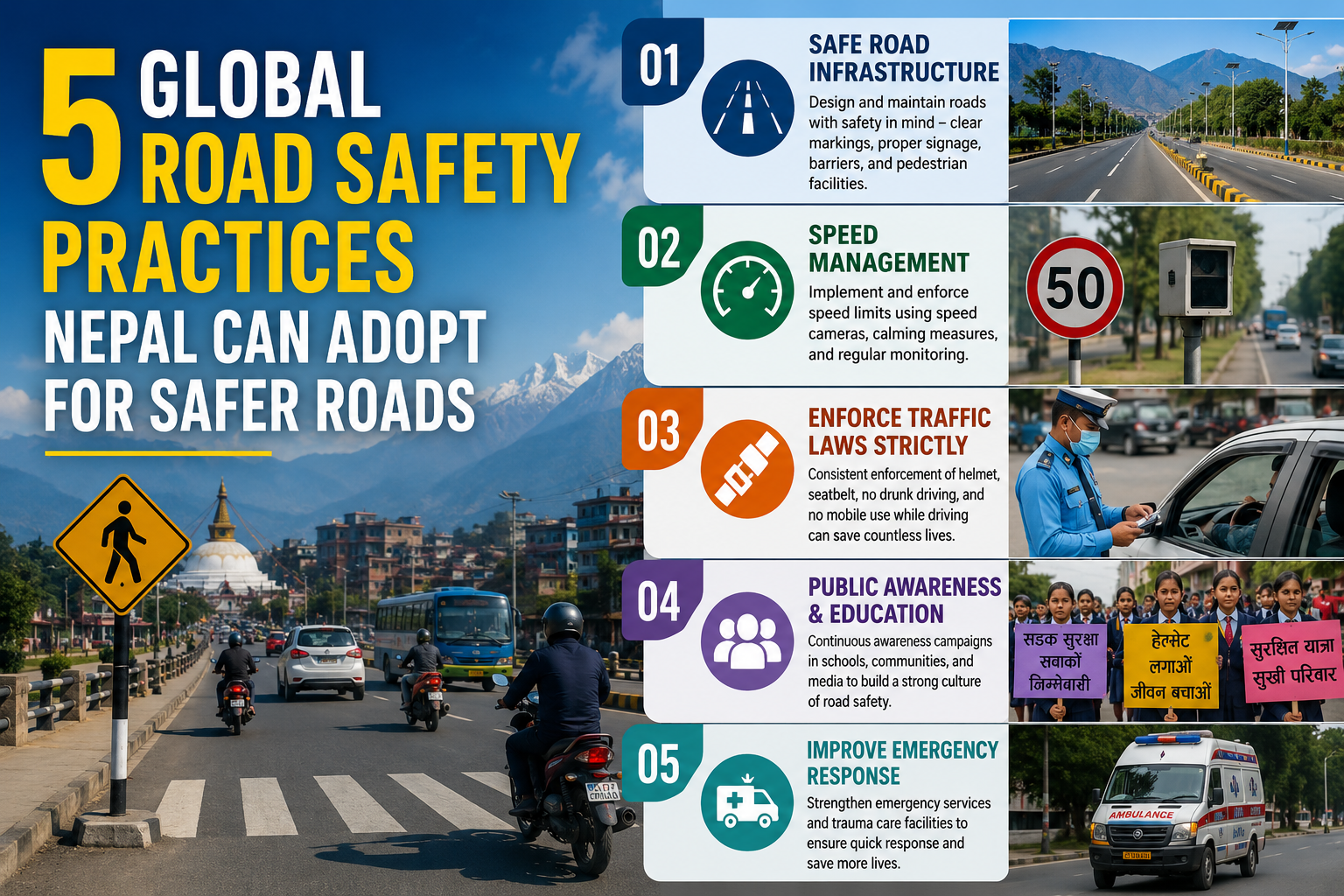
Every day in Nepal, roughly seven people lose their lives on the road, and dozens more are seriously injured. That isn't a rough estimate. It's the average drawn from Nepal Police data year after year, and it places road traffic injuries among the leading causes of death for adolescents and young adults in the country.
The numbers get harder to ignore the closer you look. Nepal's road fatality rate stands at around 28 per 100,000 people, nearly double the Asia-Pacific average. Between mid-July 2024 and mid-January 2025 alone, the Ministry of Home Affairs recorded 1,233 deaths in just over 11,000 accidents, an increase from the year before even though the total number of accidents actually went down. Motorcycles are involved in close to 70 percent of all crashes. Kathmandu Valley, along with Lalitpur and Bhaktapur, consistently shows up as a hotspot in national accident data. And the economic toll is staggering: road crashes cost Nepal an estimated 7 percent of its GDP, more than the country spends on healthcare.
None of this is unique to Nepal, though. Rapid motorization, mixed traffic, underfunded enforcement, and roads built decades before anyone thought seriously about safety are challenges plenty of countries have faced. The difference is that some of those countries have made real progress, and the practices behind that progress are well documented. Nepal already has a framework in place, the Nepal Road Safety Action Plan 2021-2030, aimed at cutting fatalities in half by the end of the decade. What's less clear is whether the specific, proven interventions that have worked elsewhere are being applied here with enough urgency.
Here are five of them, looked at through a Nepali lens.
1. A Vision Zero Mindset for Nepal's Roads
Vision Zero began in Sweden with a simple premise: no death on the road is an acceptable cost of mobility, and the system should be designed around human error rather than around the expectation that everyone will behave perfectly all the time.
Applied to Nepal, this means shifting away from a mindset where accidents are treated as unfortunate but inevitable, especially on highways and in urban centers where speed and mixed traffic collide. It means designing intersections, footpaths, and highway sections so that a moment of driver distraction or a pedestrian stepping into traffic doesn't automatically end in a fatality. The government's own road safety action plan already gestures toward this kind of thinking, but the gap between policy documents and what actually gets built on the ground remains wide.
A Vision Zero approach in Nepal would mean prioritizing the routes with the worst safety records, such as sections of the Prithvi Highway or the roads through Kathmandu Valley with the highest crash density, and treating a redesign of those specific stretches as urgent rather than aspirational.
2. Infrastructure Built for Nepal's Actual Traffic Mix
A lot of road safety comes down to whether the physical road itself makes safe behavior easy or difficult. This is arguably where Nepal has the furthest to go. As of 2024, only around 17 percent of Nepal's roads meet a decent safety rating for pedestrians, and just 32 percent meet a comparable standard for cyclists, according to international road assessment data. That leaves the vast majority of the country's road network offering little real protection to anyone outside a vehicle.
Nepal's traffic is also unusually mixed by global standards. Motorcycles, cars, buses, three-wheelers, pedestrians, and the occasional livestock often share the same narrow stretch of road with minimal separation. In cities with more uniform traffic, infrastructure fixes like roundabouts or protected lanes are relatively straightforward to design. In Kathmandu, Pokhara, or Biratnagar, the same fixes need to account for a much wider range of vehicle types and speeds moving through the same space at once.
Targeted improvements still make a measurable difference: raised pedestrian crossings near schools and markets, physical separation for motorcycles on high-speed highway sections, and better lighting and signage on the mountain roads where poor visibility and sharp curves are already a known hazard. None of this requires rebuilding the entire national highway network at once. It requires identifying the specific junctions and highway stretches with the worst crash histories and fixing those first, which is exactly the kind of prioritization that tends to produce the fastest safety gains for the money spent.
3. Stronger, More Consistent Enforcement
Nepal already has traffic laws on the books covering speed limits, drink driving, and helmet use. The gap isn't in the legislation so much as in how consistently those laws are enforced and how predictable the consequences feel to drivers.
Over-speeding remains the single largest reported cause of road accidents in Nepal, responsible for more than half of crashes in recent monthly police reports. Drink driving continues to be a major factor as well, despite an anti-drink-driving campaign that Nepal Police has run for over a decade. Part of the issue is that enforcement, while real, still isn't consistent enough across the country to change driver behavior at scale, particularly outside Kathmandu Valley where traffic police presence thins out considerably.
Countries that have seen the biggest drops in speeding and drunk driving tend to combine visible, unpredictable enforcement, such as random breathalyzer checkpoints, with automated systems like speed cameras that don't rely on an officer being physically present at every risky stretch of road. Nepal has started moving in this direction, with traffic police increasingly using fines and license penalty points, but expanding automated enforcement on the highways with the worst records, and making the odds of getting caught feel real rather than occasional, would likely do more to change driver behavior than tougher laws on paper alone.
4. Vehicle and Helmet Safety Standards
Given that motorcycles account for around 68 to 70 percent of road crash deaths and injuries in Nepal, vehicle-level safety measures matter enormously here, arguably more than in countries where cars dominate the roads.
Helmet use is mandatory by law in Nepal, yet compliance, particularly proper helmet use and passenger helmet use rather than just the rider, remains inconsistent. Basic vehicle safety features that are standard in many other markets, like anti-lock braking systems on motorcycles or reliable safety ratings for imported vehicles, are still far from universal here. Strengthening minimum safety standards for vehicles entering the market, alongside stricter enforcement of existing helmet and seatbelt laws, would directly target the crash types that make up the largest share of Nepal's road deaths.
There's also a data gap worth mentioning. Nepal doesn't have comprehensive figures on its total vehicle fleet, which makes it harder to measure motorization trends and target interventions precisely. Closing that data gap would help future safety campaigns focus resources where they're actually needed most.
5. Public Awareness Built for Nepal's Roads and Riders
Given that road injuries are now among the leading causes of death for Nepali teenagers and young adults, public awareness campaigns aimed specifically at younger riders, who make up a disproportionate share of motorcycle crash victims, deserve particular attention.
Generic safety messaging tends to have limited impact. What tends to work better is specific, repeated messaging tied to the exact behaviors driving Nepal's crash numbers: helmet use for both riders and passengers, speed limits on the highway stretches known for accidents, and the risks of drink driving during festival seasons when both traffic volume and alcohol consumption spike. Embedding road safety education into school curricula, something Nepal's own road safety framework has flagged as a gap, would also help build safer habits before young people start riding motorcycles on their own, often as early as their teenage years despite the legal driving age.
Kathmandu Valley's traffic police have already run visible awareness and enforcement drives around helmet use and drink driving. Scaling that same approach nationally, and sustaining it beyond short campaign windows, is where the real opportunity lies.
Bringing It Together for Nepal
None of these five practices works particularly well in isolation, and that's worth taking seriously given how much is already at stake. A safer road design doesn't help much if speeding still goes unpunished. Stricter drink-driving enforcement matters less if riders still aren't wearing helmets properly. Awareness campaigns fade if they aren't reinforced by consequences and by roads that make safer choices the easier ones to make.
Nepal already has the Road Safety Action Plan 2021-2030 as a framework, and the country has taken real steps, from sustained anti-drink-driving campaigns to expanded fine collection for traffic violations. What the data suggests, though, is that the pace of progress hasn't matched the scale of the problem. Fatalities have continued climbing even as the country works toward its 2030 target, and international assessments estimate that a relatively modest annual investment, well under half a percent of GDP, could save thousands of lives a year if directed at the right infrastructure and enforcement priorities.
The path forward isn't a mystery. It looks a lot like what's worked elsewhere: fix the roads with the worst records first, enforce the laws that are already on the books consistently, raise the safety floor on vehicles and helmets, and keep public awareness campaigns running long after the initial push fades. None of it is easy, and all of it costs money. But given what road crashes are already costing Nepal, in lives and in GDP, it's hard to argue the investment isn't worth making.

