Toyota’s Hydrogen Gamble: Why the Automotive Giant is Eyeing the Two-Wheeler Market
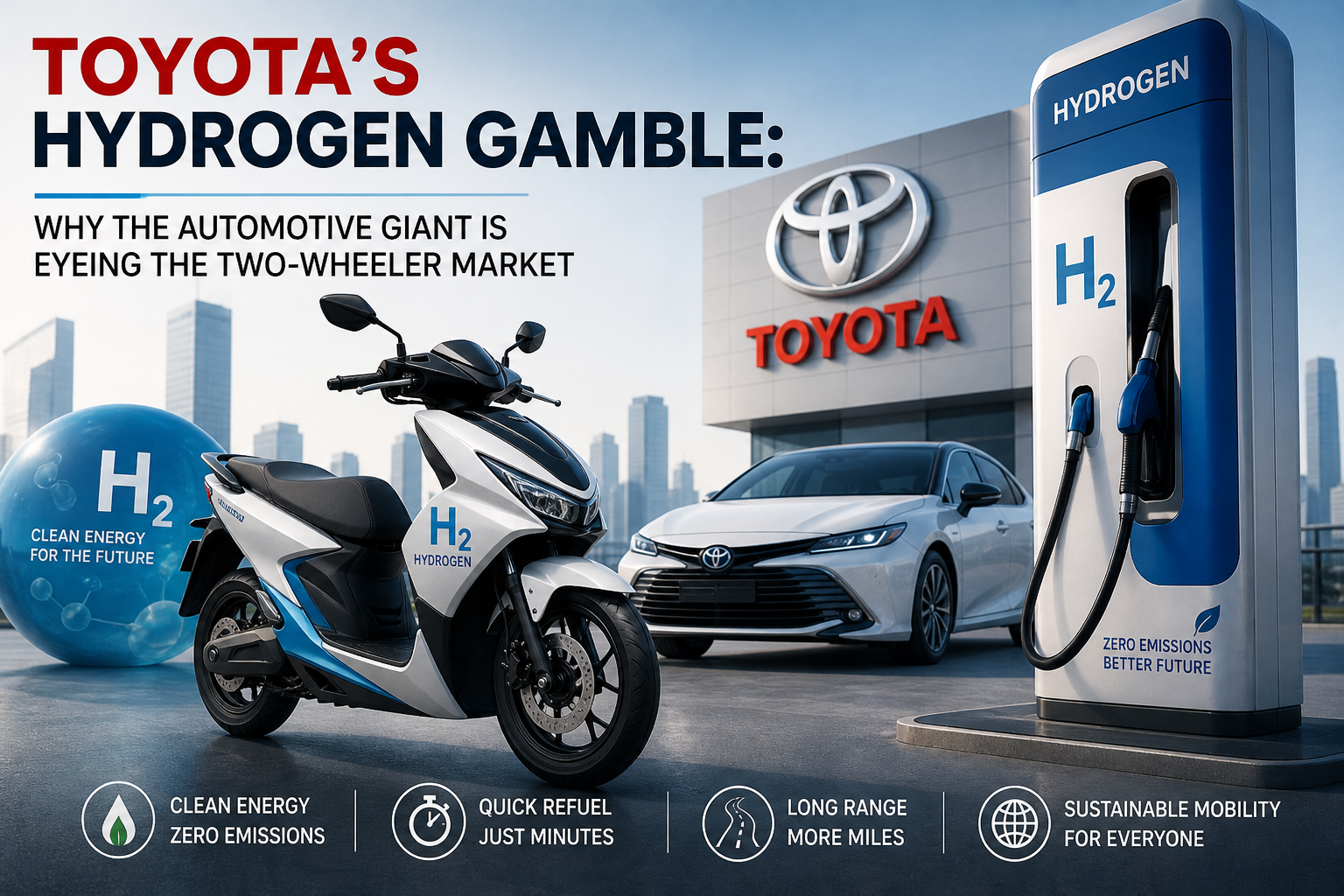
For decades, the name Toyota has been synonymous with reliability, four-wheeled efficiency, and a cautious yet firm resistance to putting all its eggs in the electric vehicle (EV) basket. While competitors like Tesla and BYD raced to dominate the battery-electric market, Toyota’s leadership most notably Akio Toyoda championed a "multi-pathway" approach. This philosophy argues that the world isn’t ready for a 100% battery-electric future due to infrastructure gaps and resource scarcity.
Now, that multi-pathway strategy is taking a sharp, two-wheeled turn. Recent patent filings and the formation of high-level industry alliances suggest that Toyota is preparing to enter the motorcycle and scooter business. But they aren't planning to launch a generic commuter bike. True to their DNA, Toyota’s first foray into two-wheelers appears to be powered by hydrogen.
The Hydrogen Scooter: More Than Just a Patent
The buzz started when Toyota filed detailed patents for a hydrogen fuel-cell-powered scooter. On the surface, this might seem like a niche experiment. However, looking closer at the technical drawings, it becomes clear that Toyota is solving the primary pain point of hydrogen mobility: refueling.
Traditional hydrogen vehicles, like the Toyota Mirai, require massive high-pressure tanks and specialized fueling stations. This doesn't work for a scooter. Toyota’s solution? Swappable Hydrogen Canisters.
Imagine a world where, instead of searching for a charging port or a rare hydrogen pump, you simply walk up to a vending machine or a convenience store and swap a spent hydrogen cylinder for a fresh one much like we do with propane tanks for grills, but on a much more compact, refined scale. This "portable power" concept is the lynchpin of Toyota’s two-wheeler strategy.
Key Highlights
-
A Strategic Alliance (HySE): Toyota isn't acting as a lone wolf. They have spearheaded the Hydrogen Small mobility & Engine technology (HySE) association. This powerhouse group includes the "Big Four" of the motorcycle world: Honda, Yamaha, Suzuki, and Kawasaki.
-
The Suzuki Partnership: The initial prototypes and patent designs are heavily based on the Suzuki Burgman 400 chassis. By using a proven maxi-scooter platform, Toyota can focus purely on the powertrain tech.
-
Fuel Cell vs. Internal Combustion: While some members of the HySE group are looking at burning hydrogen in traditional engines, Toyota is doubling down on Fuel Cell Electric Vehicle (FCEV) technology. This uses hydrogen to generate electricity, which then powers a motor, resulting in zero emissions only water vapor.
-
The "Canister" Ecosystem: The core innovation involves small, lightweight hydrogen tanks that can be carried in a backpack or stored under a seat. This bypasses the multi-billion dollar hurdle of building high-pressure hydrogen pipelines.
Features & Comfort
If Toyota brings this to market, they are clearly targeting the premium commuter segment. Based on the patent layouts and the Burgman platform, the "Toyota Two-Wheeler" is designed for the modern urbanite who demands convenience without the "range anxiety" of a battery.
-
Ergonomic Maxi-Scooter Layout: Expect a plush, step-through design with ample legroom and a tall windscreen for highway stability.
-
Whisper-Quiet Commuting: Unlike gasoline engines that vibrate and roar, the fuel cell process is nearly silent. The only sound you’ll hear is the faint hum of the electric motor and the wind.
-
Instant Torque: Electric motors provide 100% of their torque from zero RPM. This means the scooter would likely outperform 400cc petrol rivals in stop-and-go city traffic.
-
Thermal Management: One of the hidden perks of hydrogen fuel cells is that they generate heat as a byproduct. In colder climates, this heat can be redirected to warm the handlebars or the seat, providing a level of comfort that drains battery-electric bikes much faster.
Safety & Advanced Tech
The biggest hurdle for hydrogen is public perception. People hear "hydrogen" and think of volatility. Toyota’s engineering team has spent years addressing this through their work on the Mirai, and that expertise is being shrunk down for two wheels.
-
Impact-Resistant Storage: The patent shows a unique "cradle" system. The hydrogen canisters aren't just bolted on; they are housed in reinforced sections of the frame designed to survive high-impact collisions without compromising the fuel seal.
-
Automatic Shut-off Valves: In the event of a tip-over or a sensor detecting a pressure drop, the system is designed to instantly isolate the canisters, preventing any fuel from reaching the fuel cell stack.
-
Digital Integration: We can expect a full-color TFT dashboard with cloud connectivity. Given Toyota's recent moves in "Smart City" tech (like Woven City in Japan), the bike would likely communicate with the hydrogen "swap stations" to tell the rider exactly where the nearest fresh canister is located.
The Logistics of a Hydrogen Revolution
Why go through all this trouble when electric bikes already exist? The answer lies in the Energy Density vs. Charging Time debate.
For a delivery rider in a city like Kathmandu or Bangkok, or a long-distance commuter in Europe, stopping for 45 minutes to fast-charge a battery is a dealbreaker. Hydrogen offers the density of petrol with the cleanliness of electric. If the swap takes 60 seconds, the "utility" of the vehicle remains identical to the gasoline bikes we've used for a century.
Furthermore, lithium mining is becoming increasingly controversial and expensive. Hydrogen, being the most abundant element in the universe, offers a more sustainable long-term outlook provided we can produce it using renewable energy (Green Hydrogen).
A New Chapter for Toyota
By entering the two-wheeler market, Toyota is diversifying its portfolio at a critical time. They aren't just selling a bike; they are testing a portable energy ecosystem. If a person gets used to swapping hydrogen canisters for their scooter, they are much more likely to trust a hydrogen-powered car or a home backup generator in the future.
This move signals that Toyota is no longer content just being a car company. They are aiming to be a "mobility company." Whether you are a die-hard motorcyclist or a tech enthusiast, the prospect of a Toyota-branded, water-emitting, swappable-fuel scooter is a fascinating glimpse into a future that doesn't just rely on a plug in the wall.
Final Thought
The automotive world has often doubted Toyota’s "slow and steady" approach to new tech. But with the backing of the HySE alliance and a clever solution to the refueling problem, Toyota might just be the one to make hydrogen a household name one scooter at a time.
What do you think? Would the reliability of the Toyota brand be enough to make you switch from petrol to hydrogen?
For more updates on upcoming vehicle launches and the latest in automotive tech, stay tuned to our website.

