Why Many Nepalis Still Fear Buying EV Cars in 2026
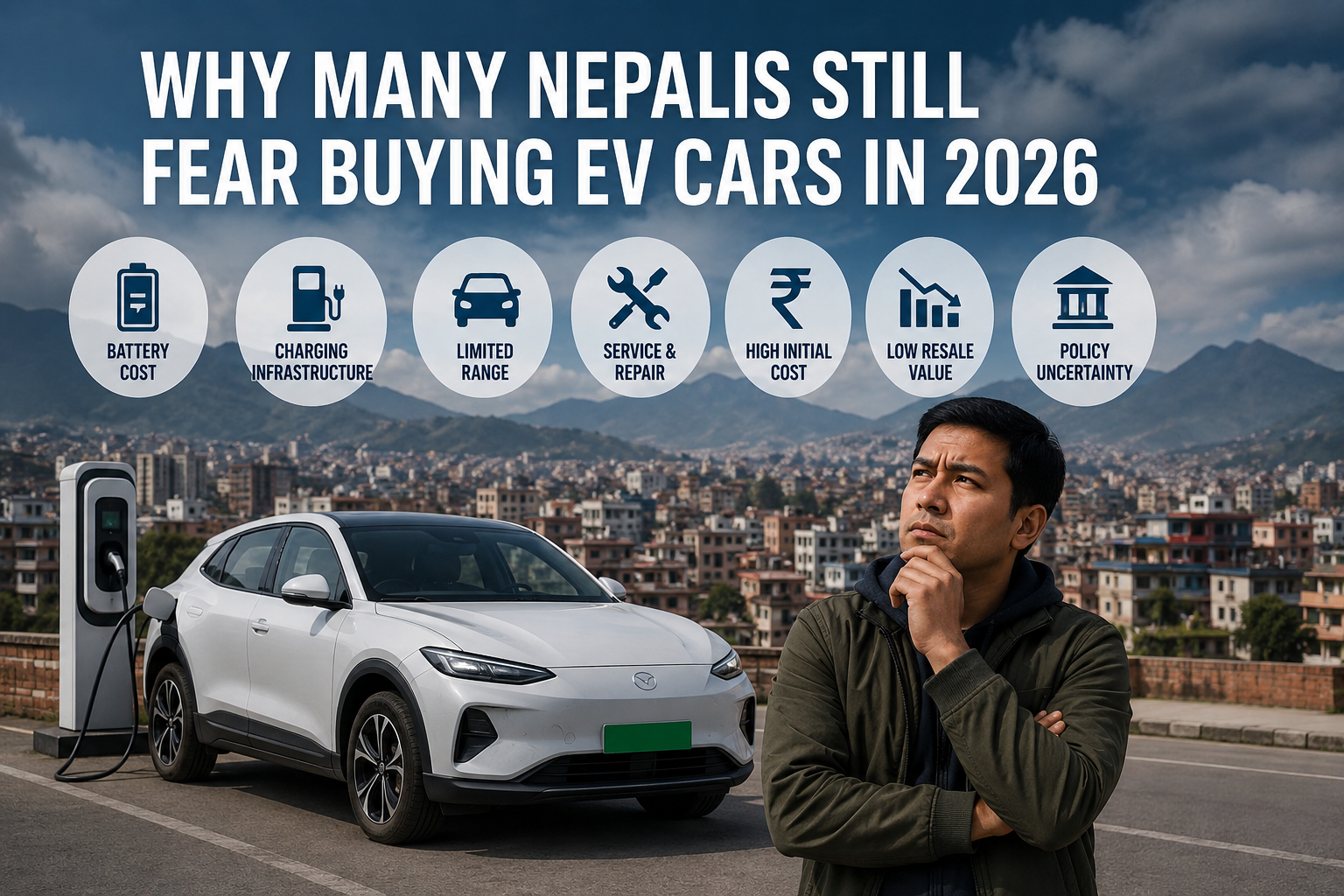
Electric vehicles are no longer rare in Nepal. A few years ago, seeing an EV on the road felt new and interesting. Today, electric cars are everywhere, especially in Kathmandu, Lalitpur, Bhaktapur, Pokhara, Chitwan, and other growing urban areas. Brands like BYD, Tata, MG, Hyundai, Kia, Deepal, Neta, Seres, Citroen, and many others have made EVs a common topic among car buyers.
In fact, Nepal has become one of the fastest-growing EV markets in the world. EVs reportedly made up around 73 percent of new car sales in Nepal in 2025, putting Nepal among the top countries globally for electric car adoption.
Still, there is a clear gap between popularity and confidence. Many Nepalis are interested in EVs, but they are not fully comfortable buying one. They ask the same questions again and again. What if the battery fails? What if I do not find a charging station on the highway? What if the government suddenly increases tax? What will happen after five or six years? Will I get resale value?
These fears are not foolish. For a Nepali family, buying a car is not a small decision. It often takes years of savings, bank finance, and careful planning. A car is not just a lifestyle product here. It is a major family asset. That is why many people still think twice before shifting from petrol or diesel to electric.
1. Fear of Battery Replacement Cost
The biggest fear among Nepali EV buyers is the battery. People often say, “EV ko battery bigriyo bhane ta gadi nai sakiyo.” This fear is understandable because the battery is the most expensive part of an electric car.
In petrol or diesel cars, people are familiar with engine problems, clutch plates, gearboxes, injectors, turbo issues, and servicing costs. They may be expensive, but buyers understand them. EV batteries are different. They are still new for many Nepali users.
Many buyers worry that after a few years, they may need to replace the whole battery pack. Since battery replacement can cost a huge amount depending on the model, people fear that an EV may become a financial burden later.
The truth is that modern EV batteries are designed to last for many years. Most companies offer battery warranties, often around 8 years or a certain kilometre limit. But Nepali buyers still ask a practical question: “Warranty sakiyepachi ke huncha?”
That is where the fear remains. Warranty gives confidence, but it does not completely remove doubt. Until Nepal has more real-life examples of old EVs running well after 8 to 10 years, many buyers will continue to be careful.
2. Charging Anxiety Is Still Real
Charging has improved in Nepal, but it is still not as easy as filling petrol or diesel. For daily city driving, EVs are very convenient if the owner can charge at home. A person who drives from home to office, school, market, and back can save a lot of money with an EV.
The problem starts when people think about long trips. Kathmandu to Pokhara, Kathmandu to Chitwan, Kathmandu to Butwal, Kathmandu to Dharan, or hill routes can still make some buyers nervous.
They wonder: Will the charger work? Will there be a queue? Will the charging station be available at night? What if the charger is occupied? What if the car range drops uphill?
Nepal Electricity Authority and private companies have been expanding charging infrastructure, and previous reports noted hundreds of charging stations across Nepal with plans for more expansion. But for many buyers, the issue is not only the number of chargers. It is reliability, location, speed, maintenance, and confidence.
Petrol pumps are everywhere and familiar. Charging stations are growing, but people still feel they need to plan too much. For first-time EV buyers, that planning feels like stress.
3. Range Drops on Nepal’s Roads
EV companies usually promote range numbers based on standard testing conditions. But Nepal’s roads are not standard. We have uphill climbs, traffic jams, rough roads, cold weather in high-altitude areas, and frequent use of AC or heater.
A car that claims 300 km range may not always give exactly 300 km in real driving. This creates fear. A buyer may think, “Company le 300 km bhanyo, tara real ma kati dincha?”
This is a valid concern. Range depends on driving style, road condition, load, speed, temperature, tyre pressure, and terrain. Kathmandu Valley driving is different from climbing to Daman, Nagarkot, Kalinchowk route, Mustang route, or hilly roads in eastern Nepal.
Nepali buyers are practical. They do not only look at brochures. They ask other owners. They check Facebook groups. They watch YouTube reviews. They want real-world range, not showroom range.
This is why many people still prefer petrol or diesel cars for long-distance confidence, even if they like EVs for daily city use.
4. Fear of Low Resale Value
Nepalis care deeply about resale value. This is one reason Toyota, Hyundai, Suzuki, Mahindra, and Tata have been trusted for years. People buy cars while already thinking about selling them after a few years.
With EVs, resale value is still developing. The used EV market exists, but it is not as mature as the used petrol and diesel car market. Buyers ask questions like:
Will anyone buy my EV after five years?
How much battery health will remain?
Will the next buyer trust the car?
Will newer EV models make my car outdated quickly?
This fear is stronger because EV technology is improving fast. New models are coming with better range, better design, faster charging, and more features. A buyer may feel that today’s EV could look outdated after just three or four years.
That is not completely wrong. EVs are improving faster than traditional cars. But as more EVs enter Nepal’s roads, the second-hand EV market will also become more organized. Battery health reports, service history, warranty transfer, and proper dealer inspection will become important in resale.
For now, however, resale uncertainty remains one of the biggest reasons many Nepalis hesitate.
5. Policy and Tax Uncertainty
Nepal’s EV market has grown partly because of lower taxes compared to petrol and diesel vehicles. EVs have benefited from government policy support, especially because Nepal produces hydropower and wants to reduce fuel imports.
The 2082/83 budget kept EV tax rates unchanged, with customs and excise duties depending on motor power. For example, EVs up to 50 kW fall under lower tax slabs, while higher-powered EVs face much higher duties.
But Nepali buyers have seen tax changes before. This creates fear. Many people think, “Aaja EV sasto cha, bholi government le tax badhayo bhane?”
This fear affects both new and used EV buyers. If taxes increase, new EV prices may rise. If new prices rise too much, used EV resale may change. If policies change suddenly, buyers may feel trapped.
Nepal’s auto market is heavily affected by government duty, budget announcements, bank financing rules, and import policies. So when buyers hesitate, they are not only thinking about the car. They are thinking about the entire system.
6. Limited Repair Knowledge Outside Major Cities
EVs have fewer moving parts than petrol or diesel vehicles. There is no engine oil, clutch, spark plug, exhaust system, or complicated engine maintenance. In theory, EVs should be easier to maintain.
But the problem in Nepal is technical familiarity. Many local mechanics know petrol and diesel cars very well. They can repair old Suzuki, Hyundai, Toyota, Tata, Mahindra, and other vehicles with experience. EVs need different skills, especially for high-voltage systems, battery diagnostics, software, sensors, and electronic components.
In Kathmandu and major cities, authorized service centers are growing. But outside city areas, buyers still worry. What if the car stops in a remote place? What if the local workshop cannot repair it? What if parts are not available?
This is a serious concern for people who travel frequently outside the valley. A buyer living in Kathmandu may be comfortable. But someone from hilly or semi-urban areas may still feel petrol or diesel is safer because mechanics are easier to find.
7. Spare Parts Availability
Spare parts are another concern. Many Nepalis have faced delays getting parts even for regular cars. With EVs, the fear is stronger because some models are new, some brands are new, and some dealers are still building their after-sales network.
People worry about small but important parts such as sensors, charging ports, body panels, infotainment units, battery modules, control units, and electronic components. If a car is in the workshop for weeks due to unavailable parts, the owner suffers.
This is why dealer reputation matters more in EVs. A good EV is not just about range and design. It is also about parts availability, service network, trained technicians, warranty support, and long-term brand presence.
Nepali buyers are slowly learning this. Earlier, people asked only, “Range kati ho?” Now they are asking better questions: “Service center kaha cha? Battery warranty kati ho? Parts stock cha? Brand Nepal ma long-term bascha?”
That is a good sign.
8. Confusion About EV Brands
The Nepali EV market has many brands now. Some are globally known. Some are newer. Some have strong dealers. Some are still trying to build trust.
According to one EV market listing, Nepal had hundreds of EV options across dozens of brands in 2026, including four-wheelers and two-wheelers. More options are good, but too many options also create confusion.
A buyer may ask, “Which brand will survive in Nepal?”
This is a fair question.
In the past, Nepal has seen vehicle brands enter the market with excitement and later struggle with service, parts, or resale. Buyers remember these things. That history affects EV confidence.
For many Nepalis, buying from a trusted dealer is as important as buying a good car. A strong brand with weak after-sales support is risky. A new brand with no proven service network is even riskier.
That is why buyers should not only compare price, range, and features. They should compare warranty, service center strength, dealer history, parts support, and customer feedback.
9. Bank Financing and EMI Pressure
EVs can save money on fuel, but the upfront price is still high for many families. Even when running cost is low, monthly EMI can be heavy.
Some EVs are affordable compared to premium petrol cars, but many desirable models are still expensive. In Nepal, where vehicle prices are already high due to tax and import costs, buying any car is a major financial decision.
Reports in 2025 also showed that EV imports were rising, but traders were concerned that reduced bank financing could affect sales. This matters because many Nepali car buyers depend on auto loans.
A person may like an EV, but if financing is difficult or down payment is high, they may postpone the purchase. Also, some buyers still calculate risk in a traditional way. They think petrol or diesel cars are easier to resell if financial pressure comes later.
10. Fear of Accidents and Battery Safety
Some people fear EV fires or battery damage after accidents. This fear is often increased by social media videos from other countries. A single viral clip can make thousands of people nervous.
Modern EVs are built with safety systems, battery protection, cooling systems, and automatic power cut-off features. But fear spreads faster than technical explanation.
In Nepal, road conditions are not always smooth. Potholes, flooding, steep roads, landslides, and rough village routes make people ask whether EV batteries are safe underneath the vehicle.
This does not mean EVs are unsafe. It means buyers need proper education. They should understand ground clearance, battery protection, water wading limits, safety rating, service inspection, and insurance coverage.
Fear reduces when information improves.
11. Electricity Supply and Home Charging Concerns
Many city EV owners charge at home, which is one of the biggest advantages of owning an electric car. But not everyone has private parking. Many people live in rented houses, apartments, shared homes, or areas where parking is outside.
For these buyers, home charging is not simple. They may need landlord permission, separate wiring, proper earthing, meter capacity, or safe parking space. Some people also worry about voltage fluctuation or charging during power issues.
Nepal’s electricity situation has improved a lot compared to the load-shedding years, and hydropower gives Nepal a strong reason to promote EVs. Nepal has no domestic oil production and depends on imported fuel, while hydropower supports cleaner electric mobility.
Still, people remember the past. Many Nepalis lived through years of load-shedding. That memory has not fully disappeared. Even if the situation is better now, some buyers still ask, “Batti gayo bhane charge kasari garne?”
12. Petrol and Diesel Feel More Familiar
Sometimes fear is not technical. It is emotional.
People know petrol and diesel cars. They know where to fuel. They know mechanics. They know resale value. They know common problems. They know how to judge engine sound. They know what to check before buying a used car.
EVs feel silent, software-based, and unfamiliar. For older buyers especially, this can feel uncomfortable. A silent car can feel strange. No engine sound can make people doubt performance. Touchscreen controls, regenerative braking, charging apps, and battery percentages may feel complicated at first.
This is not a weakness of EVs. It is a transition problem. Every new technology takes time to become normal.
Just like smartphones replaced keypad phones slowly, EVs will also become normal with use, experience, and trust.
13. Are These Fears Still Valid in 2026?
Some fears are valid. Some are outdated. Some are emotional but understandable.
Charging anxiety is still valid for long routes, but it is improving. Battery fear is understandable, but modern EV warranties help reduce risk. Resale value is still uncertain, but the market is growing. Service concerns are real outside major cities. Tax uncertainty is also real because Nepal’s vehicle market depends heavily on government policy.
At the same time, EV benefits are strong. Running cost is low. Maintenance is simpler. Driving is smooth. Instant torque is useful in city traffic. Nepal’s hydropower makes EVs more logical than fuel imports. Air pollution reduction is also important, especially in Kathmandu Valley.
Transport is a major contributor to air pollution in Kathmandu Valley, and the shift toward EVs is seen as one way to reduce pollution and improve public health.
So the better question is not “Should Nepalis fear EVs?”
The better question is: “Which EV is right for which buyer?”
14. Who Should Buy an EV in Nepal?
An EV makes strong sense for people who mostly drive inside the city, have home charging, want low running cost, and do not frequently travel to remote areas. It is also a good option for families with a second vehicle, office commuters, ride-sharing drivers in urban areas, and buyers who want modern features with lower daily operating cost.
A good EV can be a smart purchase if the buyer checks the right things before buying.
Before buying, buyers should check:
Battery warranty
Real-world range
Ground clearance
Service center network
Spare parts availability
Dealer reputation
Charging options near home and highway routes
Insurance coverage
Resale demand
Battery health report, especially for used EVs
These points matter more than fancy screens and big brochure numbers.
15. Who Should Wait Before Buying an EV?
Some buyers should still wait or choose carefully. If someone travels regularly to remote hilly areas, does not have home charging, lives far from an authorized service center, or buys cars mainly for resale value, they should think twice.
This does not mean they should avoid EVs forever. It means they should choose the right model and right brand. A cheap EV with weak support can become expensive later. A slightly expensive EV from a reliable dealer may be safer in the long run.
In Nepal, after-sales service is everything. This applies to petrol cars too, but for EVs it is even more important.
Conclusion: Fear Is Natural, But Blind Fear Is Not Useful
Many Nepalis still fear buying EV cars in 2026 because the technology is new, the investment is big, and the long-term experience is still developing. Battery cost, charging stations, resale value, tax policy, spare parts, and repair knowledge are genuine concerns.
But EVs are no longer experimental in Nepal. They are already becoming mainstream. The growth of EV sales shows that many buyers are ready to shift. Nepal’s hydropower, high fuel prices, and rising urban pollution make electric vehicles a practical choice for the future.
Still, the decision should not be emotional. Buyers should not buy an EV just because it is trending. They should also not reject EVs just because of fear.
The smart way is simple: study your driving needs, check your charging access, choose a trusted brand, understand the warranty, and buy from a dealer with proper service support.
EVs are not perfect. Petrol and diesel cars are not perfect either. But for many Nepali buyers in 2026, a well-chosen EV can be one of the most sensible car purchases they make.

